






What is the difference between a contact microphone and a geophone?
The World of Structure-Borne Sound
The overwhelming majority of sound recording equipment is engineered to function as pressure transducers, capturing acoustic energy that propagates through the air. These conventional microphones are highly sensitive to sound pressure level (SPL), which is the variation in atmospheric pressure caused by sound waves. However, this specialized focus renders them almost completely insensitive to the vast spectrum of vibrations traveling through solid objects.
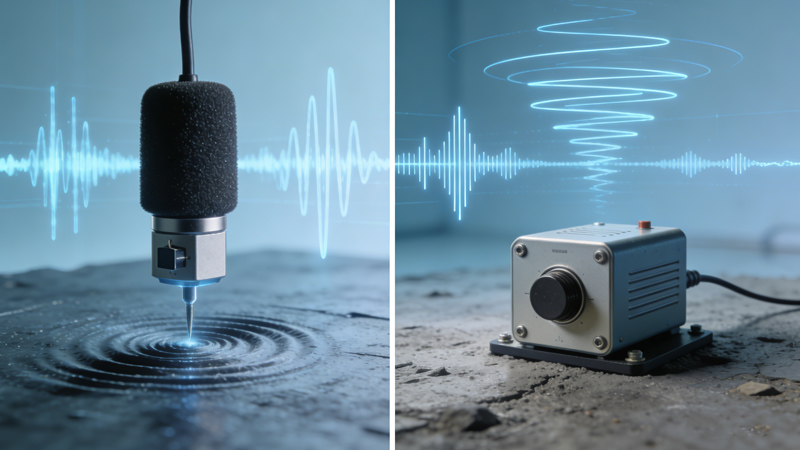
For the expert field recordist, sound designer, or geophysical surveyor, accessing this hidden acoustic domain—known as structure-borne sound—requires highly specialized sensors. This is the domain of the contact microphone (CM) and the geophone (GP). These devices are fundamentally different from air microphones because they transduce mechanical vibrations or kinetic energy traveling through solid media, bypassing airborne sound entirely.
The Focus on Kinetic Energy and Initial Distinction
Both contact microphones and geophones are designed to couple directly with a solid surface and convert those physical movements into an electrical signal. This ability allows practitioners to uncover sounds that would be impossible to capture otherwise, such as detailed resonances or deep seismic rumbles.
While their functional purpose is similar, their design specializations diverge based on their primary intended application. Contact microphones are broadly utilized by electroacoustic music artists and sound designers experimenting with textural sound, often focusing on high-fidelity capture within or just above the human audible range. Conversely, the geophone has historically been the workhorse of geophysical surveying and seismic monitoring, designed for precise, quantitative measurement of earth movement in the deep sub-sonic frequency range.
The fundamental difference in intended use, artistic exploration of audible surface resonance versus scientific measurement of sub-audible earth movement, is the causal mechanism driving their respective design specializations. This specialization directly impacts critical factors like frequency response and the nature of the output signal. The requirement for broadband fidelity in the contact microphone necessitates solving a significant electronic challenge (impedance mismatch), whereas the low-frequency specialization of the geophone allows it to largely bypass this issue entirely.
The Focus on Kinetic Energy and Initial Distinction
Both contact microphones and geophones are designed to couple directly with a solid surface and convert those physical movements into an electrical signal. This ability allows practitioners to uncover sounds that would be impossible to capture otherwise, such as detailed resonances or deep seismic rumbles.
While their functional purpose is similar, their design specializations diverge based on their primary intended application. Contact microphones are broadly utilized by electroacoustic music artists and sound designers experimenting with textural sound, often focusing on high-fidelity capture within or just above the human audible range. Conversely, the geophone has historically been the workhorse of geophysical surveying and seismic monitoring, designed for precise, quantitative measurement of earth movement in the deep sub-sonic frequency range.
The fundamental difference in intended use, artistic exploration of audible surface resonance versus scientific measurement of sub-audible earth movement, is the causal mechanism driving their respective design specializations. This specialization directly impacts critical factors like frequency response and the nature of the output signal. The requirement for broadband fidelity in the contact microphone necessitates solving a significant electronic challenge (impedance mismatch), whereas the low-frequency specialization of the geophone allows it to largely bypass this issue entirely.
The Impact of Impedance Mismatch on Piezo Contact Mics
| Input Impedance (Approx.) | Matching Device/Circuit | Resulting Frequency Response | Perceived Sound Character |
| 1.5kΩ(Typical Mic Input) | None/Direct Connect | High-Pass Filter near 1 kHz | Very Thin, Tinny, Lacking Bass 10 |
| 50kΩ(Typical Line Input) | None/Direct Connect | High-Pass Filter near 200Hz | Reduced Bass, Thin Sound |
| >1kΩ(High Z Input) | Active Impedance Converter (Buffer) 8 | Full, Flat Frequency Response (True Broadband) | Rich, Detailed, Wide Bandwidth |
The Geophone: The Workhorse of Geophysical Sensing
Physics of the Moving Coil: Electromagnetic Induction
Geophones operate on the principle of electromagnetic induction (Faraday’s Law). The mechanical structure consists of a moving coil suspended by a spring mechanism within a powerful, fixed magnetic field. When the housing moves with ground vibration, the coil resists due to inertia, inducing a voltage.
Output Signal: Proportional to Velocity (V/m/s)
The induced voltage is directly proportional to the velocity of the relative movement between the coil and the magnetic field. Therefore, geophones are inherent velocity sensors, with output scaled in Volts per meter per second (V/m/s), making them the standard instrument for measuring Peak Particle Velocity (PPV).
Design Philosophy and Reliability
Unlike the high-impedance nature of piezo crystals, moving-coil geophones exhibit inherently low output impedance. This low impedance simplifies integration into data acquisition systems, eliminating the need for specialized high-impedance buffers required by CMs. Geophones are designed for rigorous scientific applications and housed in rugged casings for harsh environments. Their specialization is rooted in low-frequency optimization, aligning the transducer’s output with the low-frequency world of seismic activity.
Technical Deep Dive: A Comparative Analysis of Performance
Frequency Response Showdown: Low-End Specialization vs. Broadband Versatility
The geophone is a specialized, narrowband instrument optimized for deep, sub-sonic (infrasound) frequencies, typically excelling from ≈ 15 Hz downwards. Scientific geophones commonly use band-pass responses designed for the 2–250 Hz range for vibration monitoring. A properly buffered CM, conversely, is the broadband alternative, capable of a flat response across the entire audio frequency range (20 Hz to 20 kHz) and sensitive to detailed texture and high-frequency transients. While high-specification CMs can reach into the infrasound range , the geophone’s design makes it intrinsically better suited for measuring deep, low-frequency oscillations.
Output Signal Characteristics and System Integration
The geophone’s velocity output inherently de-emphasizes rapid, high-frequency structural noise (like surface scrapes), allowing the low-frequency seismic signal to stand out, which is paramount for scientific measurement. The displacement-based CM is highly sensitive to surface detail and high-frequency transients. Geophones are exceptionally sensitive within their optimized band, capable of detecting minute ground motions, with minimum recordable amplitudes reported as low as 0.0159 mm/s.
Core Technical Comparison: Contact Microphone vs. Geophone
| Characteristic | Contact Microphone (Piezo) | Geophone (Moving Coil) |
| Primary Transduction Principle | Piezoelectricity (Stress/Strain) | Electromagnetic Induction 6 |
| Output Signal Type | Voltage proportional to displacement/strain | Voltage proportional to velocity (PPV) 13 |
| Output Electrical Impedance | Extremely High (Capacitive, MΩ range) 8 | Low to Medium (Ohms to low kΩ range) 5 |
| Inherent Frequency Bias | Broadband potential; strong low-frequency roll-off without buffer 8 | Strong low-frequency specialization (≈ 15 Hz+) 3 |
| Preamplification Requirement | Mandatory High-Impedance Buffer/Converter (>1 MΩ) 8 | Standard audio amplification; specialized buffer not required |
| Typical Target Frequencies | Broadband, Midrange, High Frequencies, Surface Resonance 3 | Infrasound, Deep Sub-sonic, Seismic Activity 3 |
Conclusion
The required frequency bandwidth and the electronic coupling imperatives inherent to each design fundamentally determine the selection between a geophone and a contact microphone.
Both devices are critical tools for sensing structure-borne sound, but they occupy distinct functional niches: the geophone offers rigorous, reliable low-frequency measurement, while the buffered contact microphone provides a path for high-detail, wide-bandwidth sonic investigation.
Related Products:
* Assorted Piezo Hydrophones: https://www.seis-tech.com/category/hydrophones/
* Assorted Velocity Geophones: https://www.seis-tech.com/category/geophones/
References
Alcudia-Molina, M. A. (2009). 3-D numerical modeling of ground roll for a 3-D physical-model data set (Master’s thesis). University of Calgary.
AcSoft Ltd. (n.d.). Accelerometers, Geophones and Seismometers – Which to Choose.
Ma, Y., Liu, W., & Chen, S. (2024). Moving-Coil Geophone. National Center for Biotechnology Information.
Guedes, G. V. (2008). The Geophone: A Critical Review. CREWES Research Report.
Sjogreen, A., Margrave, G., & Henley, D. (2008). Field comparison of 3-C geophones and microphones to high-precision blasting sensors. CREWES Research Report — Volume 20.


