






Is Distributed Acoustic Sensing (DAS) the End of the Geophone?
In the world of geophysical instrumentation, a technological schism has emerged. On one side stands the moving-coil geophone, the industry standard for nearly a century, celebrated for its reliability and precision. On the other side is Distributed Acoustic Sensing (DAS), a photonic technology that transforms a simple fiber optic cable into an array of thousands of virtual sensors.
For operators and geophysicists, the question is no longer just theoretical. With fiber optics offering unprecedented spatial resolution, does the electromechanical geophone still hold a place in modern exploration?
The answer lies in the data. While DAS offers a logistical revolution, the geophone remains the benchmark for signal fidelity. This article examines the physics, the data response, and the strategic application of both technologies to determine where they compete and where they collaborate.
The DAS Revolution
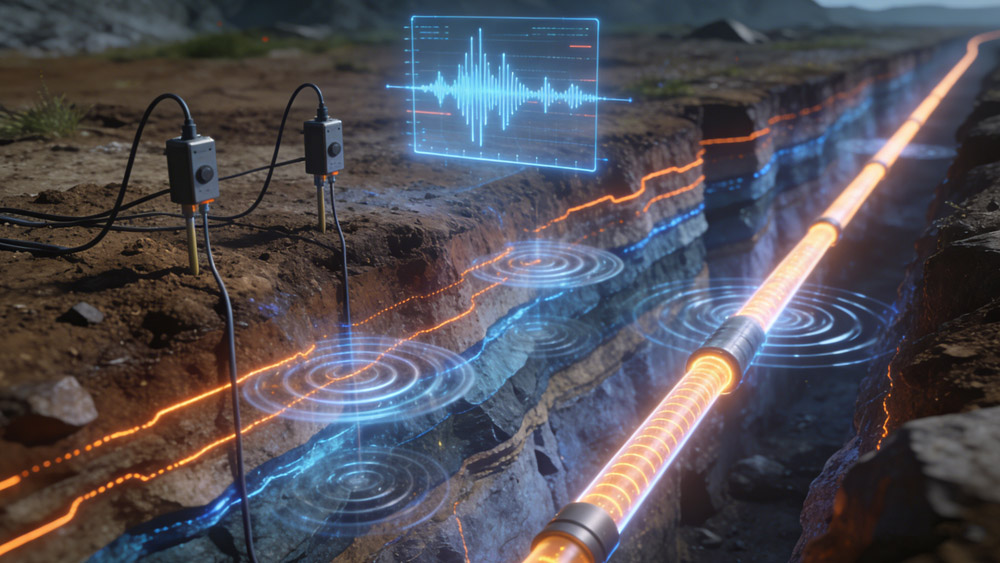
Distributed Acoustic Sensing operates on a principle called Rayleigh backscattering. By sending laser pulses down a fiber optic cable, an interrogator unit measures microscopic strain changes in the glass caused by seismic waves.
The primary advantage of DAS is Spatial Sampling Density. A single 10-kilometer cable can act as 10,000 individual sensors spaced one meter apart. Achieving this density with nodal geophones would be logistically impossible in many environments. This makes DAS a formidable tool for applications like Vertical Seismic Profiling (VSP), where deploying a heavy geophone chain into a high-temperature wellbore poses significant operational risks.
The Geophone Standard
Despite the logistical appeal of fiber, the geophone retains superiority in signal quality. This comes down to the fundamental physics of the device.
Amplitude Fidelity and Dynamic Range
A geophone generates a voltage proportional to ground velocity. This electromechanical response is linear and highly predictable. DAS, conversely, measures strain (or strain rate). Studies indicate that DAS often struggles with amplitude fidelity, the ability to record the true strength of the signal without distortion. Factors such as the coupling of the fiber to the rock and the “gauge length” of the laser pulse can smooth out high-frequency data or distort amplitudes.
The Vector Limitation (1C vs. 3C)
Geophones are inherently vector sensors. A three-component (3C) geophone records ground motion in vertical, North-South, and East-West directions. This vector wavefield data is fundamental for complex imaging tasks, such as shear-wave splitting analysis. Standard DAS is a single-component (1C) measurement. It primarily senses strain along the axial direction of the fiber. While helical fiber designs exist to mimic multi-component data, they add significant cost and complexity.
The Noise Floor
For deep exploration targets where signals are weak, the instrument noise floor is the deciding factor. High-sensitivity geophones generally exhibit a lower instrumental noise floor compared to standard DAS interrogators, providing a superior Signal-to-Noise Ratio (SNR) in quiet environments
What the Data Shows
Recent academic comparisons support the “complementary” view rather than a “replacement” view.
A 2022 study published in Frontiers in Earth Science conducted a rigorous side-by-side test of DAS and 3C geophones in a VSP survey. The researchers analyzed the amplitude and phase response of both systems.
The Finding: While DAS matched the geophones in phase response (timing), it showed discrepancies in amplitude preservation. The study highlighted that for quantitative amplitude analysis (AVO), geophones provided a more reliable dataset.
Similarly, research featured in The Leading Edge (SEG) notes that while DAS excels in acquiring massive datasets quickly, the “broadside sensitivity” (sensitivity to waves hitting the fiber at 90 degrees) drops significantly, whereas a 3C geophone captures these waves regardless of arrival angle.
Technical Comparison Matrix
To assist with instrument selection, we compare the functional characteristics of both systems below:
| Feature | Moving-Coil Geophone | Distributed Acoustic Sensing (DAS) |
| Measurement Type | Ground Velocity (Vector) | Strain / Strain Rate (Scalar) |
| Spatial Resolution | Low (Discrete points) | Extremely High (Continuous) |
| Directionality | 3-Component (Omni-directional coverage) | 1-Component (Axial sensitivity mostly) |
| Signal-to-Noise Ratio | High (The Gold Standard) | Moderate (Improving, but higher noise floor) |
| Amplitude Fidelity | High (Linear response) | Variable (Dependent on coupling/angle) |
| Temperature Tolerance | Limited (Electronics fail >175°C) | Extreme (Fiber survives >300°C) |
A Hybrid Future
Will DAS replace the geophone? For specific niche applications, it already has. However, for general seismic exploration where data quality and vector fidelity remain paramount, the geophone is not going anywhere.
The future of geophysics is likely hybrid: using fiber optics to provide the broad structural context and high-sensitivity geophones to provide the detailed, high-fidelity resolution required for complex reservoir analysis.
Related Products:
* High Sensitivity Geophone 2Hz: https://www.seis-tech.com/2hz-high-sensitivity-geophone/
References
Correa, J., et al. (2022). “Case study on amplitude and phase response comparison between DAS and 3C geophone VSP surveys.” Frontiers in Earth Science, 10. [Comparison of spectral content and signal fidelity in borehole environments].
Dean, T., Cose, R., & Hartog, A. (2017). “Distributed acoustic sensing: An alternative to geophones?” The Leading Edge, 36(12). [Analysis of directionality and sensitivity limitations of fiber optics].
Munn, S., & Yavuz, S. (2018). “Comparison of geophone and surface-deployed distributed acoustic sensing seismic data.” Geophysics, 83(5). [Surface deployment case studies highlighting SNR differences].


