






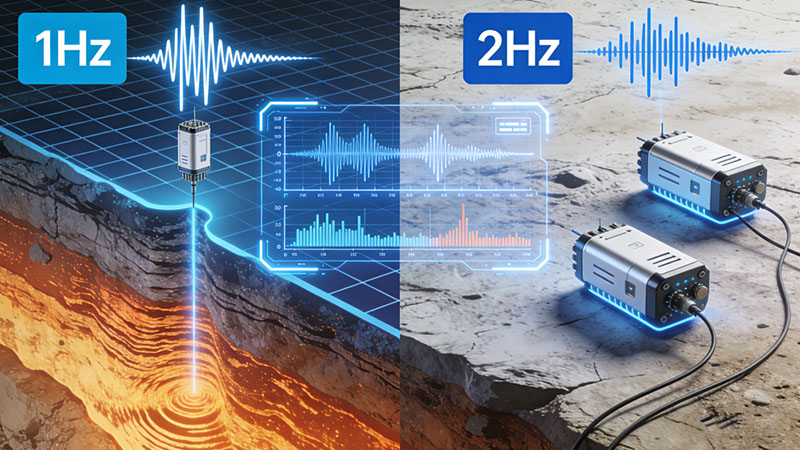
Why is the difference between 1Hz and 2Hz so important for seismic acquisition?
For decades, the geophysical industry focused almost entirely on increasing high-frequency content to achieve better image resolution. However, over the last twenty years, there has been a significant shift in interest toward the low-frequency end of the spectrum. While it might seem like a small detail, the difference between 1 Hz and 2Hz represents a major technical and financial hurdle in seismic data acquisition.
The Paradox of the Octave
When geologists are asked how low they need their seismic data to go, many suggest a range like 1 Hz or 2 Hz. On a linear scale, this looks like a tiny difference of only 1 Hz. However, in the world of signal processing, we must think in octaves rather than hertz. The jump from 1 Hz to 2Hz is a full octave. Capturing this extra octave of data often requires a massive increase in effort and cost because it demands more powerful vibration sources and much more sensitive sensors.
Four Reasons Why Low Frequency is Essential
The push for lower frequencies in seismic acquisition is driven by a need for a more complete physical understanding of the subsurface. By extending the bandwidth downward, we solve several problems that high frequencies alone cannot address.
1. Improving Resolution by Reducing Sidelobe Interference
In seismic imaging, the quality of a reflection is determined by the shape of the wavelet. While high frequencies help narrow the center of a signal to show thin layers, they often leave behind large ripples known as sidelobes. These sidelobes create a “ringing” effect that can overlap with and hide real geological features. When we add low-frequency octaves to the data, we significantly reduce the amplitude of these sidelobes. This results in a much cleaner image where the reflections are clearly separated, allowing geologists to identify the true boundaries between rock layers with much higher confidence.
2. Enhancing the Stability of Seismic Inversion
Seismic inversion is the process of converting seismic wave data into actual rock properties, such as acoustic impedance. A major challenge in this process is that most inversion models require a background “trend” to produce accurate results. Without low-frequency data, the inversion process becomes unstable and may lead to incorrect estimations of rock density or porosity. Having a strong low-frequency component provides the necessary low-end information that anchors the inversion model. This leads to a more reliable representation of the reservoir’s physical characteristics, which is essential for making drilling decisions.
3. Building High-Precision Velocity and Depth Models
Modern imaging techniques, such as Full Waveform Inversion (FWI), have revolutionized how we map the earth. FWI relies on matching recorded waves with synthetic waves to build an accurate velocity model of the ground. However, these algorithms often suffer from a problem called “cycle skipping,” where the computer gets lost between different wave peaks. Low-frequency waves have much longer wavelengths, which act as a guide for the algorithm. They provide a broad look at the subsurface velocity structure, ensuring that the model stays on the right track.
4. Penetrating Difficult Geological Layers
Certain geological features act like a mirror or a thick fog for seismic waves. Layers such as salt domes, volcanic basalt, or thick coal seams have a very high contrast in acoustic impedance, which causes high-frequency energy to scatter and weaken. Low-frequency waves are much more resilient because their long wavelengths can pass through these “hard” layers with minimal energy loss. In regions like the North Sea or the Gulf of Mexico, low-frequency acquisition is the only way for scientists to “see” the oil and gas reservoirs hidden beneath massive salt sheets. Without these low frequencies, the areas beneath such layers would remain completely dark on a seismic map.
The Impact of Low Frequency
| Benefit | Physical Mechanism | Practical Result |
| Cleaner Image | Sidelobe reduction | Easier to pick out thin geological layers. |
| Accurate Rock Specs | Inversion stability | Better understanding of porosity and fluid content. |
| Deep Imaging | Longer wavelengths | Reliable mapping beneath salt and basalt. |
| Reliable Depth | Prevents cycle skipping | More accurate velocity models for safer drilling. |
Comparing Sensors for Low-Frequency Tasks
Most standard seismic surveys use 10Hz geophones. These sensors are reliable and flat for frequencies above 10 Hz, but their sensitivity drops significantly below that point. Specifically, a 10 Hz geophone loses about 12 dB of signal for every octave you go lower. This means at 2.5 Hz, the signal is already much weaker and harder to distinguish from noise.
| Sensor Type | Low-Freq Performance | Noise Characteristics | Best Use Case |
| 10 Hz Geophone | Moderate (Standard) | Very low self-noise | General commercial oil and gas. |
| 5Hz High-Sensitivity | Good | Better signal-to-noise | Deep crustal or high-resolution tasks. |
| MEMS Accelerometer | Excellent | Higher 1/f electronic noise | Broadband recording and DC response. |
Overcoming Noise and Signal Processing Challenges
All electronic recording systems produce a type of noise called 1/f noise, which naturally increases as the frequency gets lower. This creates a challenge because as we try to record 1 Hz or 2 Hz signals, the sensor’s own electronic noise becomes louder.
To fix the weak response of a 10 Hz geophone at low frequencies, geophysicists use a process called inverse filtering. This mathematical correction flattens the response and corrects the phase of the signal. This process only works if the original signal recorded by the geophone is still stronger than the background noise. If the signal is too weak, the inverse filter will only amplify the noise, making the data useless.
This is why using a high-sensitivity 5 Hz geophone or a low-noise MEMS sensor is often a better choice for low-frequency projects.
Managing Source Energy: Explosives vs. Vibrators
Generating low-frequency energy is just as important as receiving it.
Explosives naturally produce a wide range of frequencies, but they are difficult to control.
Modern seismic vibrators, in contrast, can be programmed to sweep at very low frequencies.
However, forcing a heavy vibrator to shake at 1 Hz or 2 Hz requires massive hydraulic force and careful mechanical management to avoid damaging the equipment or distorting the signal.
Conclusion
There is no one-size-fits-all solution for low-frequency seismic recording. While 10 Hz geophones remain the industry standard due to their availability and low cost, the future is moving toward specialized low-frequency sensors.
Choosing between a 5 Hz geophone array or a digital MEMS sensor depends on the specific noise levels of the environment and the depth of the target. Ultimately, gaining that extra octave of data from 2 Hz down to 1 Hz is difficult, but the reward is a significantly clearer and more accurate picture of the Earth.
More information
High Sensitivity Geophone 5Hz: https://www.seis-tech.com/geophone-5hz/
High Sensitivity Geophone 2Hz: https://www.seis-tech.com/2hz-high-sensitivity-geophone/
Low Frequency Geophone 1Hz: https://www.seis-tech.com/low-frequency-geophone-1hz-2/
Reference
Baeten, G., et al. (2013). The use of low-frequency data in seismic reservoir characterization. First Break, Volume 31.
Lansley, M. (2021). Low Frequency Land Seismic Data Acquisition: What’s the difference between 1 Hz and 2 Hz
Operto, S., & Virieux, J. (2009). An overview of full-waveform inversion in exploration geophysics. Geophysics, Vol. 74.
Peterson, J. (1993). Observations and Modeling of Seismic Background Noise. · Tenghamn, R., et al. (2012). The importance of the low frequency octave for seismic imaging. SEG Technical Program Expanded Abstracts.
Ziolkowski, A. (2003). Seismic data through basalt. First Break, Volume 21.


