




Core Seismic Algorithms and Data Processing in Mining Applications
When discussing seismic monitoring in the mining industry, the conversation often begins and ends with hardware. Whether deploying 14 Hz geophones for surface exploration or high-sensitivity 4.5 Hz triaxial sensors for underground microseismic networks, selecting the correct physical sensor is critical. However, hardware is merely the first step.
Mining environments are notoriously chaotic. They generate continuous mechanical noise and complex wavefield scattering. The true value of a geophone array does not lie solely in the voltage it generates but in the algorithms and data processing workflows used to translate those raw waveforms into actionable geomechanical insights.
Here is a practical look at the mathematical data processing techniques that drive modern mining seismology.
Microseismic Monitoring for Quantifying Rock Mass Stability
In underground operations, the surrounding rock mass continuously redistributes stress as ore is extracted. This process generates microseismic events, which are tiny and localized fractures that serve as early indicators of rock bursts or slope failures.
Automated Phase Picking
Because manual analysis is impossible for continuous monitoring, engineers rely on automated phase-picking algorithms. The industry standard is the Short-Term Average to Long-Term Average (STA/LTA) trigger. By continuously comparing the amplitude of an incoming wave against the background seismic noise, the algorithm accurately detects the arrival times of Primary (P) and Secondary (S) waves.
The trigger ratio Ri at a given time sample i is calculated using the squared amplitude of the seismic signal xj:
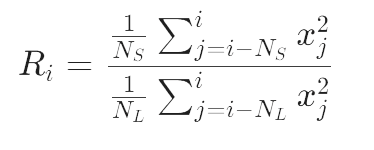
Here, NS represents the short-term window length to capture the transient seismic event, and NL represents the long-term window length representing ambient noise. A trigger is declared when Ri exceeds a predefined threshold.
Hypocenter Localization
Determining the exact 3D location of a triggered event requires nonlinear least-squares inversion techniques like Geiger’s method. Utilizing a calibrated 3D velocity model of the mine, the algorithm iteratively minimizes the residual error between the observed travel time and the theoretical travel time. By calculating spatial adjustments iteratively, the exact spatial coordinates of the rock fracture are successfully pinpointed.
Attenuating Industrial Noise in Harsh Environments
Underground mines and open pits are saturated with continuous mechanical noise from tunnel boring machines, haul trucks, and heavy ventilation fans. This dynamic noise easily masks the high-frequency signals of micro-fractures.
Standard filtering is often insufficient. To preserve the integrity of transient microseismic phases, data processing relies on the Fast Fourier Transform (FFT) to convert time-domain signals into frequency spectra. By transforming the raw waveform data into the frequency domain, engineers can pinpoint continuous industrial hums. This allows the processing software to apply targeted spectral notching to mathematically eliminate specific mechanical frequencies without distorting the underlying transient seismic wavefields.
Blast Vibration and Regulatory Compliance
In open pit operations, daily explosive blasting requires rigorous vibration monitoring to protect pit wall integrity and ensure compliance with environmental regulations.
The critical data metric is the Peak Particle Velocity (PPV). Because blast-induced ground motion propagates spherically in all directions, regulatory standards mandate the use of triaxial geophones. The processing software cannot simply look at one axis. It must continuously compute the true vector sum of the three orthogonal axes (Vertical, Transverse, and Longitudinal). The software calculates this by taking the square root of the sum of the squared velocities across all three axes to find the absolute maximum peak vibration.
By pairing this maximum PPV vector sum with the dominant frequency of the blast, mine operators plot the data against regulatory threshold curves. This algorithmic output allows blasting engineers to optimize explosive charge weights for future rounds.
Deep Structural Targeting in Mineral Exploration
Mineral exploration relies on the same fundamental seismic principles as the oil and gas industry, but hard rock environments present unique processing challenges. The impedance contrasts between different rock types are often subtle, and the geology features severe lateral velocity variations.
Exploration geophysicists are increasingly adopting Full Waveform Inversion (FWI) to utilize the entire seismic wavefield rather than just travel times. FWI frames the subsurface imaging problem as a massive optimization task. The algorithm seeks to minimize the misfit objective function E(m) by continuously calculating the least-squares error between the computationally modeled seismic data dmod and the physically observed geophone data dobs:
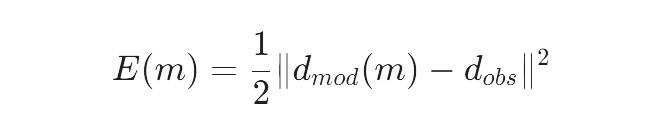
By iteratively updating the velocity model parameter m to minimize this error, FWI provides unparalleled and high-resolution mapping of deep ore bodies.
Clean Data Starts with Reliable Sensors
Advanced mathematical processing algorithms are only as effective as the raw data fed into them. High background noise from poorly coupled sensors or restricted analog bandwidth will render the best inversion software mathematically unstable.
Browse Geophones Suitable for Mining Applications
Seis Tech supplies ruggedized and high-fidelity geophones engineered specifically for the demands of the mining industry. Look through these geophones and find the right hardware foundation for your processing workflows.
Low Frequency Geophone 1Hz
Triaxial Geophone 2Hz
Three Component Geophone 4.5Hz
Borehole Triaxial Geophone 10Hz
Reinforced Geophone 14Hz
Rugged Geophone 28Hz
High Frequency Geophone 40Hz
High Frequency Geophone 60Hz
High Frequency Geophone 100Hz
References
- Zeng, Z., et al. (2025). A Review of Microseismic Source Location Techniques in Underground Mining. MetaResource, 2(3), 157-181.
- DU-Net: A Dual-Path Architecture for High-Contrast Velocity Anomaly Detection in Seismic Inversion. (2026). Minerals, 16(5), 530.
- Attenuation of blast-induced vibration on tunnel structures. (2024). Geohazard Mechanics.
- Prediction of ground vibration due to mine blasting in a surface lead-zinc mine using machine learning ensemble techniques. (2023). Scientific Reports.


